
This is the first in our new series highlighting compounds from the Shulgin legacy. Each month (more or less), we’ll explore a different molecule—its chemistry, its effects, its place in the broader story of consciousness exploration. In honor of Valentine’s Day this month, we’ve chosen 2C-B for this first one. Join us as we document not just what was created, but what the Shulgins’ work and life continues to awaken in all of us.
Research and writing by Brad Burge
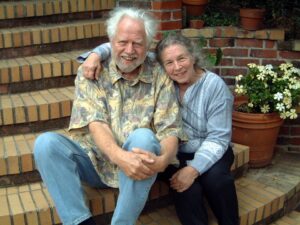
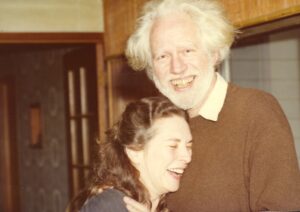
Sasha called 2C-B a “warm hug”—here with Ann.
2C-B: A Warm Hug in Molecule Form
There’s a passage in PIHKAL where Sasha describes hanging crystals with Ann earlier in the day, then later that evening finding himself becoming the light itself—watching it refract and dance in kaleidoscopic patterns while music became “voluptuous, almost three-dimensional.” He was exploring 2C-B, the compound he would eventually call one of his fondest creations and describe simply as a “warm hug.”
Among the hundreds of molecules Sasha synthesized throughout his career, 2C-B held a special place. It was part of his “magical half-dozen”—the phenethylamine compounds he rated as most significant—but more than that, it embodied the qualities he sought throughout his life’s work: potent yet gentle, brief enough for therapeutic sessions, visually rich without overwhelming the psyche, and remarkably free of physical toxicity.
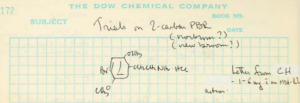
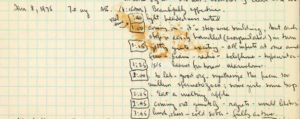
From Sasha’s notes during his first threshold experience with 2C-B: “2:05: Eat a melting apple.”
The Chemistry of Connection
Sasha first synthesized 2C-B—technically 4-bromo-2,5-dimethoxyphenethylamine—in 1974. Its structure makes it a chemical cousin to mescaline, another member of the phenethylamine family that Sasha held in high regard. But where mescaline requires substantial doses and lengthy experiences, 2C-B offered something more accessible: a 4-8 hour journey that began with threshold effects around 10 milligrams.
The compound’s dose-response curve is steep and fascinating. At 15-25 milligrams users often report enhanced sensory perception, geometric visuals, and what many describe as increased emotional openness. Objects seem to breathe, colors intensify, and laughter comes easily. Move up to 35 milligrams or beyond, and the experience becomes considerably more intense, though Sasha cautioned against exceeding 45 milligrams.
What sets 2C-B apart from many psychedelics is this particular combination of effects. Users often describe it as occupying territory between LSD and MDMA—the “love child,” as it’s affectionately known. There are the characteristic psychedelic visuals, but they tend toward geometric patterns rather than the organic, flowing forms associated with tryptamines. There’s emotional warmth and empathy, but also a reportedly clearer headspace than compounds like LSD or psilocybin.

The Shulgins’ living room, where they worked with individuals using 2C-B and other compounds.
Warm, Graceful, Erotic
In 2003, Sasha told the Center for Cognitive Liberty and Ethics: “[2C-B] is, in my opinion, one of the most graceful, erotic, sensual, introspective compounds I have ever invented. For most people, it is a short-lived and comfortable psychedelic, with neither toxic side-effects nor next-day hang-over.”
The erotic quality he mentions appears repeatedly in descriptions of 2C-B. Ann wrote of experiences where her “body was flooded with orgasms—practically from just breathing.” Sasha himself speculated that if an effective aphrodisiac were ever to be found, it would likely be patterned after 2C-B in structure. This wasn’t mere romanticism; it reflected consistent reports from the more than 200 individuals they worked with using 2C-B for therapeutic purposes.
Between the mid-1970s and 1995, when 2C-B became a Schedule I substance in the United States, Ann and Sasha used it in therapeutic contexts to address anxiety, depression, PTSD, nightmares, and even one memorable case of supposed “possession.” Their approach was characteristically methodical: careful dosing, supportive settings, meticulous documentation of subjective effects. A German pharmaceutical company briefly marketed 2C-B under the name Erox as an aphrodisiac, and German psychiatrists Dr. Friederike Fischer and her husband used it therapeutically with 97 clients, often in combination with MDMA.
While none of this work resulted in formal clinical trials—the regulatory environment shifted too quickly—Dr. Ben Sessa’s later interviews with the Fischers revealed “overwhelmingly positive” patient outcomes with no serious adverse reactions, psychoses, or hospitalizations.
The Science Catches Up (Slowly)
Research into 2C-B remains frustratingly sparse, a consequence of both its Schedule I classification and timing. Sasha synthesized it after the first wave of psychedelic research had already been shut down, leaving little opportunity for formal investigation before prohibition.
The most significant recent study, published in 2023, recruited 22 healthy volunteers with prior psychedelic experience. In a double-blind protocol, participants received 20 milligrams of 2C-B, 15 milligrams of psilocybin, or placebo on separate occasions. The findings aligned with decades of anecdotal reports: 2C-B produced effects “closely related to other drugs such as MDMA,” with more frequent mood changes than perceptual alterations. Participants reported less negative emotion and feeling less cognitively impaired compared to psilocybin, despite similar performance on cognitive tasks. The experience was described as “lighter,” particularly regarding mystical or ego-dissolving qualities.
The shorter duration—generally 4-6 hours compared to psilocybin’s 6-8 hours—adds another potential therapeutic advantage. There’s currently one active study at University Hospital in Basel, Switzerland, comparing different doses of 2C-B to MDMA, psilocybin, and placebo.
It’s not much, but it’s a beginning.
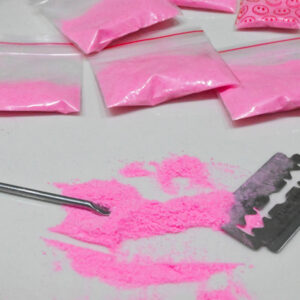
“Tusi” is often confused with 2C-B, but most samples contain little or none of the original drug.
Photo credit: Getty Images
A Cautionary Note
The story of 2C-B isn’t complete without addressing what happened in South America’s nightclub scene. Starting in the late 2000s, wealthy young adults in Medellín brought small quantities from Europe, where it gained cachet as an “elite” imported drug. Early dealers mixed the powder with pink food coloring—both to mask the notorious pain of snorting 2C-B and to create a distinctive brand.
“Tusi” (a phonetic play on “two-C”) took off. But as demand exploded, supply couldn’t keep pace. What emerged was a pink powder cocktail containing little to no actual 2C-B—instead bulked with caffeine, ketamine, MDMA, and other substances—sold at prices 33 times higher than cocaine. The United Nations Office on Drugs and Crime reported in 2021 that actual 2C-B remains extremely rare in South America.
It’s a stark reminder that street drugs rarely contain what they claim, and that the careful, considered approach Sasha and Ann modeled stands in sharp contrast to recreational markets driven by profit and mythology.
Sasha describes his experience with 2C-B: “This delicious feeling of being alive.”
“Gratitude for Even a Glimpse”
Sasha once wrote: “How long will this last, this delicious feeling of being alive, of having penetrated the veil which hides beauty and the wonders of celestial vistas? It doesn’t matter, as there can be nothing but gratitude for even a glimpse of what exists for those who can become open to it.”
He was describing his experience with 2C-B, but he could have been describing his life’s work itself. Each molecule was an attempt to map inner territory, to create tools for therapeutic healing and self-exploration. 2C-B embodied that mission with particular grace: potent without being overwhelming, visual without being confusing, warm without losing its psychedelic edge.
The compound remains a Schedule I substance with limited research and considerable legal barriers. Yet it stands as testament to what’s possible when rigorous chemistry meets compassionate curiosity—when molecules are understood not just as structures on paper, but as potential catalysts for healing, connection, and wonder.
That was always the Shulgin way: document carefully, share openly, remain curious about what we don’t yet understand. Whether 2C-B will one day fulfill its therapeutic promise remains an open question, but the foundation Sasha and Ann built—both in their lab and in their meticulous documentation—ensures that future researchers won’t be starting from scratch.
Resources for Further Exploration
PIHKAL: A Chemical Love Story – Alexander and Ann Shulgin’s foundational work documenting the synthesis and effects of phenethylamines, including detailed reports on 2C-B
Erowid 2C-B Vault – Comprehensive collection of experience reports, chemistry information, and safety data
2C-B, the Forgotten Psychedelic: Understanding the “Love Child” of Alexander and Ann Shulgin on Psychedelics.com – Contemporary overview of 2C-B history and effects