
This is the second in our series highlighting compounds from the Shulgin legacy. Each time, we explore a different molecule—its chemistry, its effects, its place in the broader story of consciousness exploration. This month, we turn to methylone: a compound first synthesized by Alexander “Sasha” Shulgin and Peyton Jacob III in the mid-1990s, later swept into designer-drug markets, and now being studied as a potential treatment for PTSD.
Research by Brad Burge, founder of Integration Communications
Not every Shulgin molecule entered the world through the pages of PIHKAL. Some arrived later, after the historic book had already gone out into the world. Some lived behind-the-scenes in patents, notebooks, and scientific papers before the culture knew what to do with them. Some, like methylone, waited decades for the world to catch up.
Methylone—also known as 3,4-methylenedioxy-N-methylcathinone, MDMC, or beta-keto-MDMA—is incredibly close to MDMA on the chemical family tree. Add a single oxygen atom at the beta position of MDMA’s phenethylamine backbone, and you arrive at methylone. That’s just one small change, a slight rearrangement of atoms that shifts the character of the experience.
Sasha, as usual, noticed those differences. He described methylone as having an “almost antidepressant action,” pleasant and positive, but not quite “the unique magic of MDMA.”
That sentence captures a lot of methylone’s story. It’s familiar, but not identical, to MDMA. It’s described as warm and heart-opening, but not legendary in quite the same way. It’s related to one of the most famous empathogens in the world, yet distinctly its own molecule.
And now, 30 years after Sasha and Peyton Jacob III first synthesized it, and somewhat by surprise, methylone has become one of the most closely watched compounds in the emerging field of psychedelic medicine.
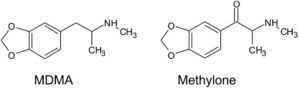
Methylone differs from MDMA by a single beta-ketone oxygen—small on paper, meaningful in experience. (Image courtesy of Frontiers.)
A Late-Blooming Shulgin Molecule
Methylone was first synthesized by Peyton Jacob III and Alexander Shulgin in the mid-1990s, after the 1991 publication of PIHKAL. That’s why it doesn’t appear among the phenethylamines documented in the original text, though it was later included in The Shulgin Index.
Jacob and Shulgin patented methylone thinking that it might be useful as a potential antidepressant or antiparkinsonian agent, though it was never developed or marketed for those purposes. Like so many molecules in the Shulgin lineage, it began not as a product but as a question: What happens when we make this? What does it reveal? What might it teach us about mind, body, chemistry, and healing?
That question was never Sasha’s alone. The story of methylone is also the story of Peyton Jacob III, his co-inventor, whose role deserves to be named clearly. Chemistry is often remembered through singular figures, but discovery is rarely so solitary. The Shulgin world was built through friendship, collaboration, correspondence, trust, and shared curiosity. Methylone belongs to that broader web.
Chemically speaking, methylone is a substituted cathinone, the cathinone analogue of MDMA. Cathinones are a family of compounds related to cathinone, the naturally occurring stimulant found in the khat plant. In methylone’s case, the familiar methylenedioxy ring system of MDMA is the same, but the beta-ketone shifts the pharmacology and the psychological effects.
While MDMA has become nearly synonymous with emotional openness, touch, connectiveness, and therapeutic possibility, methylone is often described as gentler, shorter, and more stimulant-like. It acts primarily as a serotonin, norepinephrine, and dopamine releasing agent, increasing the availability of those neurotransmitters in the brain. Unlike classic psychedelics like psilocybin, LSD, or mescaline, methylone does not appear to act meaningfully through 5-HT2A receptor agonism, the pathway most associated with visual or hallucinatory psychedelic effects. In other words, methylone is psychoactive, empathogenic, and entactogenic, but it isn’t a classic psychedelic.
The Chemistry of Similarity
As Ann and Sasha knew, there is something poetic about molecules that differ by only a small structural feature. In the laboratory, a single atom looks almost trivial. On paper, it may be a line, a bend, a letter, a single mark in what Sasha humorously called his “dirty pictures.” In the body, it can become a different tempo, a different emotional contour, a different duration, or (importantly) a different risk profile.
Methylone’s effects have often been compared to MDMA, and for good reason. In animal discrimination studies, methylone substitutes for MDMA, meaning animals trained to recognize MDMA respond to methylone in nearly the same way. In human reports and pharmacological studies, methylone has been associated with euphoria, stimulation, increased sociability, enhanced empathy, and feelings of well-being.
Methylone appears to have a faster onset and shorter subjective duration than MDMA, often described as lasting roughly two to three and a half hours. Its elimination half-life in humans has been measured at around six hours, and controlled human studies have described physiological effects such as increased heart rate, blood pressure, body temperature, and pupil dilation.
The shorter arc may also carry its own challenge. In nonmedical settings, substances with briefer durations can invite redosing, which may increase risk. That’s one reason Sasha and Ann’s method remains so important: careful attention to dose, setting, physiology, subjective experience, and documentation. A molecule’s meaning and risk potential changes dramatically depending on whether it is approached with patience and respect or rushed through the machinery of the market.
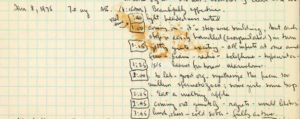
The Shulgin method was not only synthesis, but careful attention—dose by dose, note by note.
From Archive to Underground
By the early 2000s, methylone had left the obscure world of chemistry papers and patents and entered the designer-drug market. It appeared in underground markets sold under names like “Explosion” in Europe and “Ease” in New Zealand. Later, in the United States, methylone became associated with the wave of substituted cathinones often simplified in media coverage under the phrase “bath salts” (a term that created more panic than understanding).
This was a familiar pattern: a molecule born in careful inquiry gets separated from its original context, renamed, repackaged, and sold into settings where purity, dose, and identity are uncertain. The same happened with MDMA in the early 1980s. The result is confusion, and sometimes danger.
Methylone’s legal status followed that cultural shift. It became controlled in many countries and was placed in Schedule I in the United States in 2013. Today, outside approved research or other lawful contexts, it is still prohibited in the U.S. and many other jurisdictions.
Methylone may have therapeutic potential. It also has the potential for misuse. It can also increase heart rate and blood pressure, disturb sleep, and carry risks when used without medical oversight, accurate dosing, or (when it’s acquired in illegal or unregulated markets) without knowing its purity.
The Clinical Return
In recent years, methylone has reemerged under a new name: TSND-201.
Transcend Therapeutics has been developing TSND-201 (their proprietary formulation of methylone) for post-traumatic stress disorder (PTSD), with additional interest in conditions such as generalized anxiety disorder and major depressive disorder. The company describes the compound as a rapid-acting neuroplastogen (a substance intended to promote adaptive change in the brain).
The PTSD program has now become one of the most visible examples of a Shulgin-lineage molecule entering modern drug development. In 2026, results from a Phase 2 randomized clinical trial of TSND-201 in adults with severe PTSD were published in JAMA Psychiatry. The study reported significant and clinically meaningful reductions in PTSD symptoms compared with placebo.
Unlike MDMA-assisted psychotherapy studies that paired drug administration with intensive talk therapy, Transcend’s approach used four once-weekly dosing sessions monitored by a single licensed clinician providing non-directive support. In other words, the company appears to be asking a question that regulators, clinicians, and researchers increasingly care about: How much benefit comes from the molecule itself, and how much comes from the surrounding therapeutic container?
This is a question that sits at the heart of the current psychedelic renaissance.
Sasha and Ann understood that molecules and setting could never be fully separated. Ann’s therapeutic presence, the Farm, the music, the trust among research group members, the careful attention to inner life—all of this shaped what became possible with the compounds. But modern clinical research must isolate variables, measure outcomes, and design treatments that can be evaluated and, if approved, delivered responsibly at scale.
A Billion-Dollar Moment
On March 27, 2026, Otsuka Pharmaceutical announced that it would acquire Transcend Therapeutics in a deal worth up to $1.225 billion, including $700 million upfront and up to $525 million in future sales. The acquisition centers in part on TSND-201 for PTSD.
Less than a month later, the U.S. Food and Drug Administration announced national priority vouchers for three programs studying treatments for serious mental illness: psilocybin for treatment-resistant depression, psilocybin for major depressive disorder, and methylone for PTSD.
A priority voucher is not an approval or a declaration that a medicine is safe or effective. It is a regulatory mechanism meant to accelerate review if and when a pharmaceutical developer (“sponsor”) submits a new drug application. The hard work of Phase 3 research, safety assessment, data review, clinical training, and public trust still remains.
So here we are: A compound first synthesized by Sasha Shulgin and Peyton Jacob III in the mid-1990s—once obscure, then controversial, then controlled—is now being advanced by a major pharmaceutical company and recognized by federal regulators as part of a serious effort to address PTSD.
That arc would have seemed unlikely not long ago. It also shows that the field is moving beyond the question of whether psychoactive medicines can produce meaningful therapeutic effects. Increasingly, the question is how such treatments can be studied rigorously, delivered safely, and integrated into healthcare systems without losing sight of the human beings at the center.

The Farm remains a bridge between the origins of modern psychedelic chemistry and the questions now facing the field.
What Methylone Asks of Us
Methylone asks us to practice the kind of discernment Sasha and Ann modeled so well. They didn’t approach molecules with fear, nor with blind enthusiasm. Instead, they approached them as if they were teachers.
Sasha’s genius was not only that he made new compounds. It was that he created a method of attention around them. Ann’s genius was not only that she helped hold the human space in which these compounds could be explored, but that she understood that chemistry alone was never the whole story.
Whether methylone will fulfill its therapeutic potential is still an open question. But its return to scientific attention confirms that the Shulgin legacy is still alive in the questions researchers are still asking, the molecules still being studied, and the communities still working to bring rigor, compassion, and wonder to the exploration of consciousness.
Resources for Further Exploration
The Shulgin Index (out of print)– Includes methylone among the extended catalog of Shulgin-related compounds not covered in PIHKAL.
PIHKAL: A Chemical Love Story – Alexander and Ann Shulgin’s foundational work documenting the synthesis and effects of phenethylamines.
JAMA Psychiatry – “Efficacy and Safety of the Neuroplastogen TSND-201 for the Treatment of PTSD,” the 2026 randomized clinical trial of methylone in adults with severe PTSD.
ClinicalTrials.gov – Listings for TSND-201 studies in PTSD.
Erowid Methylone Vault – Historical, chemistry, effects, and safety information, including experience reports and cultural context.
FDA April 2026 announcement – National priority vouchers for programs studying psilocybin and methylone for serious mental illness.