
Welcome to Three Questions, a series where we invite Shulgin Foundation board members, advisors, supporters, and friends to share their reflections on the legacy of Sasha and Ann Shulgin and the work we are building together. These conversations offer glimpses into the hearts and minds of those carrying this remarkable legacy forward.
In this conversation, we hear from Kim Carson, the artist behind The Portal of the Collective Imagination, a 16-foot interactive arch headed to Black Rock City for Burning Man 2026. Two years after her first Burning Man, and with no history of bringing monumental art to the playa, she reorganized her life around the idea. Much of the Portal has been built at Shulgin Farm, where a team of engineers, fabricators, artists, and volunteers has spent months turning drawings into something that will stand in the desert.
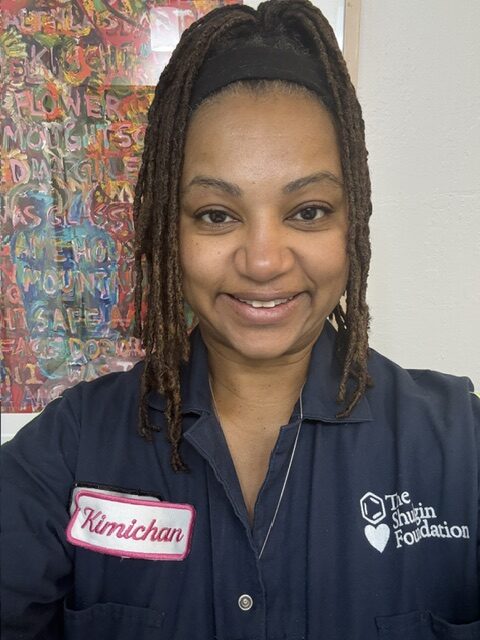
Kim Carson from The Portal of Collective Imagination
1. What is the origin story of this project? Where did the inspiration come from?
The Portal of Collective Imagination began as a question I have been pondering for over a decade. What would technology feel like if it were designed for wonder, reflection, and shared authorship instead of extraction, speed, and control?
I have spent years working in and around artificial intelligence, and I have watched AI become one of the defining technologies of our time. But so much of the conversation around it focuses on productivity, automation, optimization, and control. The Portal is my counter-argument. It asks whether AI can become something more human, more intimate, and more communal, a mirror that helps us see ourselves and each other differently.
The piece itself is a 16-foot interactive arch headed to Black Rock City for Burning Man 2026. By day, it stands as a threshold in the desert. By night, it listens and responds. Sound, breath, and voice feed a local AI system running entirely on edge hardware. There is no cloud, no internet, and no data leaves the playa. The Portal transforms those traces into imagery, text, and sound across the structure. Every person who passes through contributes to a kind of collective memory field.
The inspiration also comes from older forms of gathering: ritual thresholds, storytelling circles, sacred architecture, and the feeling of entering a space where something in you becomes more available. I wanted to make a work that feels both ancient and futuristic. It is a place where strangers can co-create something neither could have made alone.
2. Tell us about your team. What is it like to build a project like this around volunteers?
This project is a beautiful lesson in collective imagination becoming literal. It may have started as my vision, but no version of the Portal reaches the playa because of one person. It takes builders, technologists, organizers, artists, donors, volunteers, friends, and people who simply show up at the right moment with the right kind of energy.
Our core team includes Nan Pico, who helps hold the project management and scheduling structure; Reggie Hillmon, who coordinates volunteers, Jesse Elliott, who leads Leave No Trace, Dave Mathews, who guides much of the hardware and technical direction, and Carson Newman, who supports the AI and machine learning side. We also owe a deep debt of gratitude to John “Parts” Taylor, an extraordinary build lead who has managed projects on playa for more than 20 years. Parts brings the kind of calm, practical wisdom that only comes from having solved real desert problems again and again, and his guidance has helped make the Portal feel buildable, not just imaginable. On the interaction side, Josh Baillon, Kaz, and Chuck Yust from Collective Imagination are shaping the participant experience. They are the masters of how voice, movement, presence, and choice become part of the living world inside the Portal. Around that core is a growing circle of builders, fabricators, carpenters, artists, organizers, and helping hands who keep making the project more real each week.
Building around volunteers is humbling because it forces you to be clear about both the vision and the work. People are giving their time, bodies, skills, weekends, tools, and trust. That means the build must be organized enough that people feel useful, safe, and respected, but open enough that they can bring their own creativity to it. Some days are glamorous in the way big art can be glamorous. Most days involve sawdust, clamps, cables, snack runs, spreadsheets, and someone figuring out how to make the impossible slightly more practical.
The best part is watching people begin to feel ownership. Someone comes for one workday, sands one piece, helps move one pile of material, solves one wiring problem and suddenly the Portal is not “Kim’s project” anymore. It becomes something they are helping bring into the world. That is exactly the spirit of the artwork itself.
3. What has it been like to do this project at the Farm, and what drew you to the space?
Building at Shulgin Farm has felt deeply right. From the beginning, I was drawn to the Farm because it has the rare feeling of being both practical and mythic. It is a working place, full of materials, tools, constraints, weather, dirt, and logistics and it is also a place with history, imagination, and a real sense of possibility.
The Farm has given us room to move the project out of drawings and conversations and into the physical world. We began with cleanup and site organization, and then moved into wood work, CNC lamination, podium construction, and the slow choreography of getting a large-scale installation ready for the desert. There is something powerful about seeing volunteers gather in a place like Shulgin Farm and turn abstract plans into tangible progress.
I also feel a real responsibility to the space. We are guests there, collaborators there, and temporary stewards while we build. We have tried to approach the Farm with respect: keeping activity contained to designated areas, coordinating around Farm events, managing volunteers carefully, and treating Leave No Trace as a practice that starts long before we arrive on playa. The goal is not just to build something ambitious at Shulgin Farm, but to be the kind of project that leaves the Farm cared for and appreciated.
What has meant the most is that the Farm does not feel like a neutral backdrop. It feels like part of the story. The Portal is about collective imagination, and Shulgin Farm has become one of the first places where that imagination has had enough room to become real.