
Welcome to Three Questions, a series where we invite Shulgin Foundation board members, advisors, supporters, and friends to share their reflections on the legacy of Sasha and Ann Shulgin and the work we are building together. These conversations offer glimpses into the hearts and minds of those carrying this remarkable legacy forward.
In this conversation, we hear from Alysiana Carter, Shulgin Archival fellow and PhD student at the Graduate Theological Union in Berkeley focused on the psychedelic humanities, psychedelic literature, and questions of influence in psychedelic phenomena.
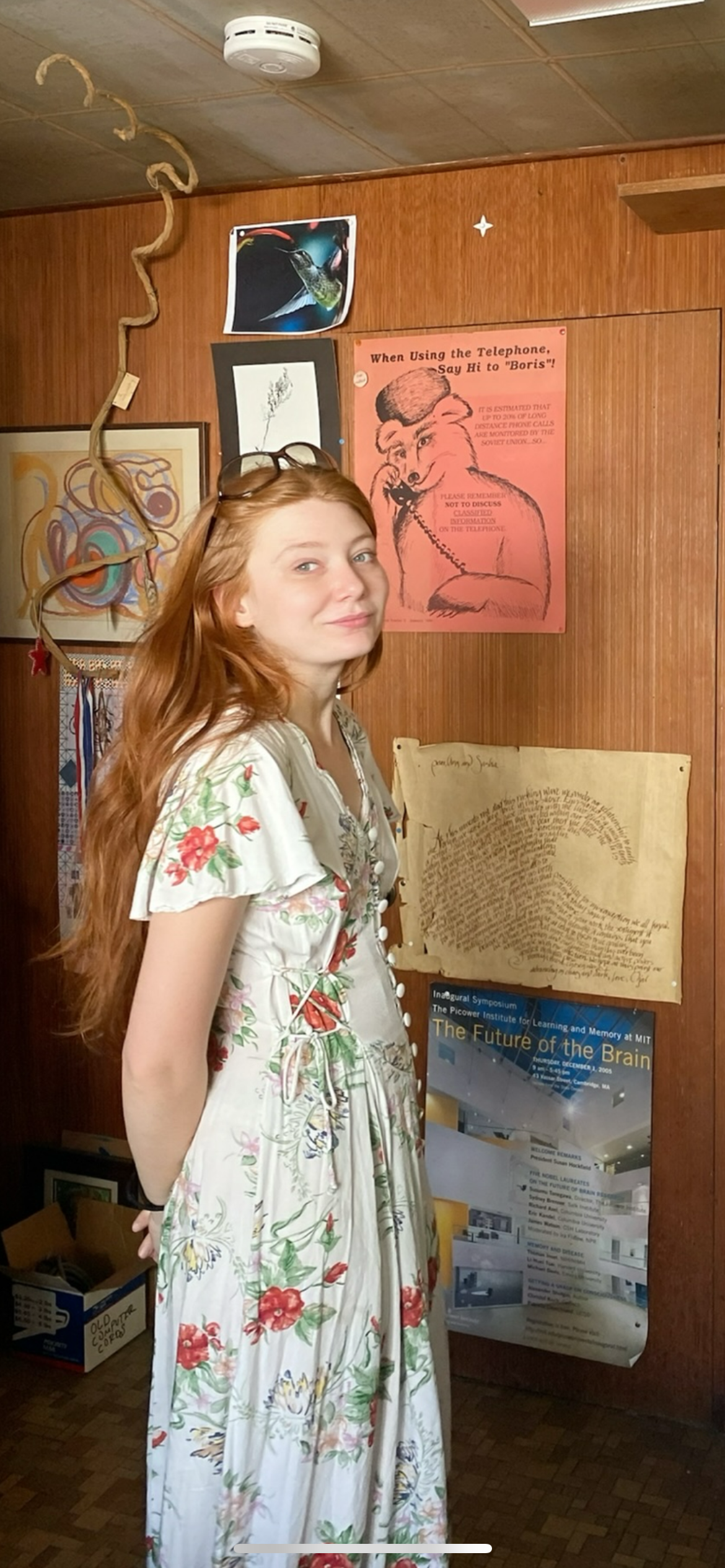 Shulgin Archival fellow Alysiana Carter
What drew you to archival work, and what makes working with Ann and Sasha Shulgin’s collection meaningful to you?
There are so many things that drew me to this work. A large portion is my research. I’m working on my Ph.D. at the Graduate Theological Union, where I study the cultural history of the psychedelic underground. I am particularly interested in influence in psychedelic phenomenologies. I explore how psychedelic experiences are described in various forms of media, and how these descriptions emerge in secondary accounts. I’m interested in exploring if recurring psychedelic themes or phenomena point to a shared objective reality, or if these recursions are a product of suggestibility. For example, are the “machine elves” commonly reported in DMT trips evidence of a liminal world, or did Terence McKenna’s description provide a scaffolding for the next generation of psychonauts to interpret their experience through? This line of questioning requires a close analysis of the cultural matrices and media influences which surround psychedelic experiences. In my case, this research has been enabled by my immersion in the archives.
As much as the archives enable my research, they also get me out of my head. I never thought I would really relish data entry, but there is nothing in the world like a nice monotonous sorting task after thinking too hard and too long. I also always joke that working in the archive feels a lot like thrifting – it’s a lot of sifting through dusty old junk looking for gems. Of course, I never have to go very long before finding treasure in the Shulgin archive.
Getting to work on the archive has genuinely been the greatest honor of my life. I’ve been obsessed with Ann and Sasha since I was a teenager when I first saw Hamilton Morris’ pieces on them. Obsessed as I was, I never got to meet them, being alternately too young or too shy to reach out and tell them how much their work meant to me. I was finally mustering up the courage to write to Ann when she passed. When I started my Ph.D. a few years later my number one goal was to make my pilgrimage to the Farm. Events hadn’t really begun again yet, but I thought if I played my cards just right I could leverage my scholarly status to come see it once in my career.
I barely had to wait three months. I came to the very first event the Foundation hosted after Ann’s memorial, and to my immense incredulity, not only was I welcomed wholeheartedly into the Shulgin community, I was given the chance to come work on their archives. As an emerging psychedelic scholar, having access to these materials is the greatest gift I can imagine. But for me, beyond any research access, the best part of working in the archive is how it’s enabled me to feel like I really know Ann and Sasha. I’ve been delighted by so many of their notes and doodles, and it’s been so meaningful for me to get to know their humor and personality through the archive.
Is there a part of the collection you’re especially eager to explore, and what do you hope it might reveal about Ann and Sasha’s lives or work?
It’s a difficult question to answer, because there is still so much I have yet to see. The full scale of the archive really hit me when I was researching for the MDMA: From Molecule to Movement exhibit. Mercifully for me, Sasha had created an annotated bibliography of materials on MDMA, which were (largely) constrained to one filing cabinet. Of course, this cabinet still contained thousands of documents, and we have several dozen of these cabinets in the office alone. All this to say, the archive contains approximately one hundred thousand worthwhile rabbit holes to follow into Wonderland. But I’ll describe two that are of particular interest to me.
Early on in the research process for the MDMA exhibit, our board member Mariavittoria Mangini suggested that a future exhibit could focus on Sasha and the research group’s role in the history of human bioassay and self-experimentation. I’ve never been able to get that idea out of my head, and I really hope we can figure out a way to create some public scholarship focused on that history.
I’m also totally fascinated by these three rice paper art pieces the Shulgins had. They’re clearly Tantric (evident from both the imagery and the label), and I’m so curious about what their significance was to Ann and Sasha. I love how the archive allows me to get a sense of what systems and thinkers were influential to Ann and Sasha’s own work, and I really hope I can make some progress tracing this particular segment of Indra’s net.
What goes into turning such an immense collection into an accessible archive, and how do you hope people will use it?
As for what has gone into making this archive accessible: many years of work from countless incredible people! I am constantly humbled by the dedication and care that has allowed the archive to persist. It was a gift that Ann and Sasha chose to collect and save these materials, especially in an environment where many of their peers were understandably choosing to destroy psychedelic materials for fear of persecution. It’s a gift that Ann’s children chose to hold the archive and the Farm for the community. It’s a gift that so many people, particularly the Erowid team, have dedicated so many years to preserving these materials.
I was lucky enough to help with the Erowid team’s final sorting push – cataloging all the books in the collection, scanning all the original documents, and painstakingly redacting sensitive information so that these materials can ultimately be made public. It’s mostly data-entry, dust mitigation, and draft dodging (in the cold house, of course). While efforts to make Ann and Sasha’s material fully accessible to the public are still underway, great precedents have been set. The publication of PIHKAL and TIHKAL are perhaps the greatest representation of the Shulgins’ open-source ethic and method, and much of the contemporary work follows this model. For example, Sasha’s Pharmacology Notebooks, containing his titration notes and his and the research group’s trip reports, have been digitized by the Erowid team and are available on their website. Hopefully in time, the entire archive will be accessible in such a manner, which will create so many incredible new inroads for researchers.
I’ve also been so enthusiastic about the public scholarship the Foundation has been producing, particularly the archival exhibits we’ve curated, and our ongoing Oral History series. My next dream / scheme is to create an interdisciplinary Shulgin research team and produce new material for publication. All these public scholarship offerings are so vital for bringing in new researchers, and for demonstrating the scope and value of the archive.
Most of all, as we are leaving the era of the underground, I want the Shulgin archive to be integrated into psychedelic history – which means we need people to know about it, to research it, and to write about it. Between the politically motivated destruction of knowledge and materials concerning psychedelic history, and the reticence of the academy to consider these materials as legitimate, there is a terrifying dearth of primary sources facing future psychedelic scholars. The time is now to insist upon the value of these materials.
This was something Sasha wrote about as well:
“So why am I writing on this morbid topic of mortality? Because at some time in the future, I too will die, and I am playing a guessing game as to what will happen to my strange collection of books, filing cabinet drawers of reprints, infrared and mass spectra atlases, lab books, and hundreds and hundreds of reference samples of stuff I have synthesized over the last forty years. A lot of the technical details are safe, having been recorded in the books PIHKAL and TIHKAL. These will be around for a long time, and what is in them is public information. My chemical ideas will be remembered, but I will not be. I am destined to be lost to the forgetfulness factor of the human animal in maybe two generations. It would be exciting to discover a psychedelic library… and let this pile of memorabilia have a lasting home.” (Alexander Shulgin, Mortality, 2001).
I wish I could tell Ann and Sasha how exciting it was for me to find their psychedelic library. I wish I could finally tell them how much their work meant to me; I would have so much more to say now.